Fake Charity Nerd Girl

resist microstructural oppression

Posts tagged #listen to economists they know things

worldoptimization

https://twitter.com/robinhanson/status/1228668492972462083

I find Robin Hanson’s reaction here … not wrong really (it’s true that markets are good sources of information! and it’s good to bet on your beliefs!) but sort of amusingly quaint

economist: are you saying … a Market … is Wrong

me, a Market Professional: yes yes I know! there are lots of markets that are wrong, and that market is on my list already, but it’s behind about a hundred others, and I’m trying to fix them all, but also I need to like sleep okay

worldoptimization
sapphichat
Source URL: https://64.media.tumblr.com/2e0ae2d47ddae783c2d16156866748e4/a614ec28b7d82920-08/s640x960/5686a966eb2a5ef42bf1fa6227510db2297aaf69.jpg

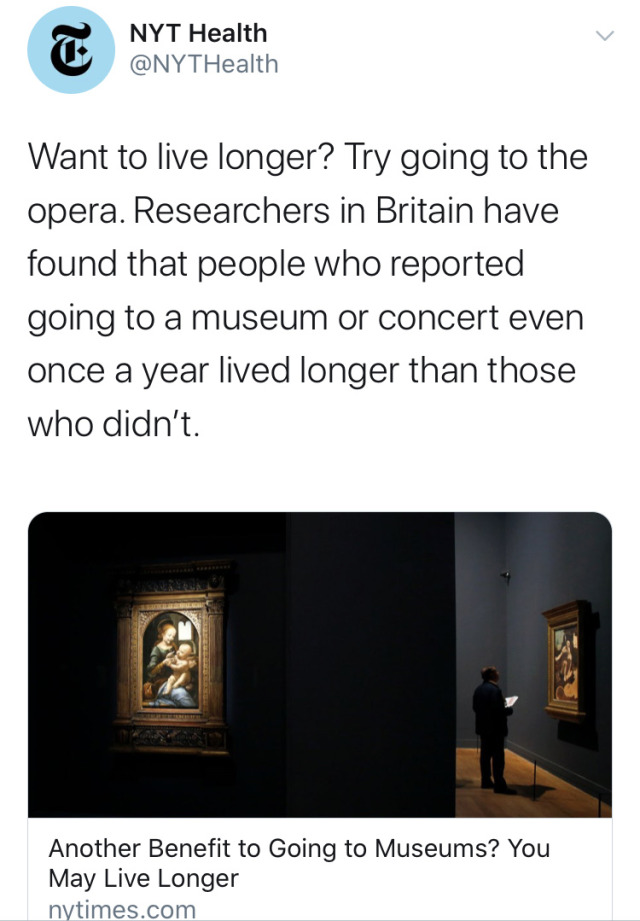
this week in I Am Very Smart: having enough money to go to the opera, museums and concerts correlates with having enough money for food, shelter and basic health needs

cyborgfirelord

They controlled for socioeconomic factors though! The people who conducted this study knew that people with lots of money to attend the opera were also more likely to be able to afford basic necessities, so they controlled for it in their analysis. The fun thing about statistics is that you can control for different confounding factors so you can look at the effects of one independent variable (opera or whatever) on the dependent variable (mortality). Part of being critical of potential biases is actually reading the article and knowing what to look for.

starstuffandalotofcoffee

In addition to that very good point about controlling for socioeconomic factors, the article says a single museum or concert per year makes a difference. Most cities have free community concerts (some even have free opera performances!) and museums that are either free, pay-what-you-want, or at least have specific days/times during which they are free or at a significantly reduced cost. Many libraries (which are free) provide free museum passes to card holders. In fact, the article quotes a museum worker who works at a free art museum in Baltimore.

If you actually read the article you would also read that educators are excited about this study because it provides evidence that the arts should be made more accessible financially - by restoring arts programs in the public schools, for example.

genatrius

So basically what they’re saying is that enriching your life and discovering new things is good for your physical health. That’s actually cool as hell.

lanibgoode

so i’m confused. can someone explain how you can “control for socioeconomic factors”? 

poverty affects every single part of your life.

it is why we eat the foods we eat (cheap and less nutritious), where we live (poorer neighborhoods have poorer air and water quality), which doctors you see (only certain doctors take certain insurances and the ones who take low-income insurance like medicaid are always overworked, overbooked, and burning out), it affects how much time you have to devote to things like exercise and recreation.

how do you erase how it touches you when it touches everything?

hrovitnir

It’s “controlled for” statistically. I haven’t actually read this properly, but in remotely decent research they take data about all factors and use tests designed to prevent making dubious correlations.

So rather than just comparing all people on just opera Y/N vs lifepan/health outcomes, it’s grouping people based on multiple factors at once. It’s not perfect, but it can tease out whether the only people experiencing the benefit also have higher income and your relationship will become weak.

My statistics game is weak, but basically you need to use multivariate analysis, and this requires specialised software.

From a website explaining multivariate analysis:

Multiple regression analysis, often referred to simply as regression analysis, examines the effects of multiple independent variables (predictors) on the value of a dependent variable, or outcome. Regression calculates a coefficient for each independent variable, as well as its statistical significance, to estimate the effect of each predictor on the dependent variable, with other predictors held constant. Researchers in economics and other social sciences often use regression analysis to study social and economic phenomena. An example of a regression study is to examine the effect of education, experience, gender, and ethnicity on income.

Ie: you are using statistical tests to look at the relationship between all your different variables at once, so if the relationship is actually between factors that are not what you’re interested in, that will show up.

@kawuli Does that explanation make sense? I hope this is actually something you were interested in hearing, @lanibgoode, my apologies if not!

kawuli

It depends on the methods used but basically, they collect a bunch of socioeconomic data like income, where you live, education, etc.

Then they predict your lifespan based on those data. A good way to simplify is to think of an x - y plot with income on the x axis and years lived on the y axis. There’s going to be some line sloping up from left to right.

Then they separate people into two groups based on whether they went to the opera (or whatever) and they get two lines, where the one for opera goers is shifted up a little bit on the y axis.

Say for the no opera people life expectancy is 65 at $10k/year and 80 at $500k/year (these are completely made up numbers). Maybe for the with opera group it’s 68 at $10k/year and 80.5 at $500k/year.

The difference between those lines is the impact that opera going makes, controlled for income.

In reality this is a confusing Thing constructed in like 8-dimensional space (1 dimension per variable you want to control for) instead of a line, but the principle holds.

(disclaimer: you can do this badly and get nonsense, I have not evaluated the statistical methods used in this paper or making any judgment on the validity of the results)

findingfeather

Given it is quite literally a Holiday Joke about How You Can Use Statistics Weirdly by the BMJ which the NYT reported VERY BADLY ON … .

(Very seriously: THE BMJ WAS JOKING. THIS WAS A JOKE PAPER.)

millievfence

I don’t see anything on the paper page that would let me detect it was a joke.

worldoptimization

After googling a bit I don’t think this is a joke?

It’s from the BMJ Christmas issue.

According to the website, “While we welcome light-hearted fare and satire, we do not publish spoofs, hoaxes, or fabricated studies.”

And the Times interviewed one of the coauthors for their article and he seemed perfectly serious.

So basically I feel like everyone involved in this looks pretty bad:

The BMJ, for being very unclear about the epistemic status of their Christmas articles, which seems irresponsible for a medical journal.

The New York Times, for just generally sucking.

And the authors, for publishing a bad study. In fairness, they say “This study was observational and so causality cannot be assumed,” which is true. But in that case, why is there any value in the study?

It’s true that you can use statistics to control for things: in this case, it looks like they tried to control for socioeconomic status, health, etc. But once you’ve controlled for all the stuff you can think of, you’re still left with two hypotheses: that going to museums increases your lifespan, or that some unobserved variable Z causes both going to museums and increased lifespan. Z could be something else you haven’t thought of, or it could be something you tried to measure but did so imperfectly. Eg, you try to measure health by taking a bunch of vital statistics, but there’s some measurement error, and some natural variation in people’s blood pressure from day to day. So you end up with an imperfect measure of health, and it turns out that going to museums is somewhat correlated with people’s true level of health that you’ve failed to perfectly measure.

In this case, the latter hypothesis sounds more likely to me. It could be the former, it’s not crazy. But the study hasn’t really done much to distinguish between the two. This is why we have experiments, and instrumental variables, and other stuff that social scientists have come up with to actually measure causality.

worldoptimization

I think I’ve mentioned being raised by economists meant already growing up with a lot of rationalist/EA values–the biggest one that was missing was what I guess people call “taking ideas seriously.” I’m higher on this dimension than the rest of my family, which was enough to get me into EA in the first place, but I’m still lower than average for EA I think. 

I was at a dinner party the other day with some (unrelated to me) academic economists. One brought up a recent study about CO2′s effects on cognition and said something about how in forty years atmospheric CO2 would be high enough that we’d start seeing noticeable effects. Another said “well, I guess by then maybe the robots will have taken over anyway.” The tone was like … kind of flippant but not really joking, and in response people like, nodded and shrugged.

It’s interesting to see ideas about AI risk getting more accepted among certain groups, and how they just don’t get taken seriously, but I guess taking ideas seriously is pretty rare.

worldoptimization

is anyone else bothered by Bryan Caplan’s attitude toward causal inference or is it just me

(or if you have justifications for why you think it’s true that’s cool too. what I’ve gotten from The Case Against Education is “quasi-experimental designs are too complex to be trusted and if you just control for everything you can think of that’s probably good enough”)

worldoptimization

Perhaps most telling was the question on pay: Only 14 percent of female economists said the gender wage gap is largely explained by differences in education and voluntary occupational choices while 54 percent of male economists agreed with that notion.

women are one fourth as likely as men to agree with true empirical facts, that’s why we should hire more of them

worldoptimization

I get really annoyed by the number of people I see who are like “Alice Wu’s study shows that the economics profession is sexist!”

like, that study is only surprising to someone who has literally never been on EJMR

saying “this study shows the economics profession is sexist” is equivalent to saying “the existence of this creepy internet forum shows the economics profession is sexist” but I guess the second one sounds less authoritative so people say the first?

(”study finds elevated use of homophobic slurs on 4chan”)

not to mention that afaik there are no equivalent sites for e.g. math or physics, so using the discourse on this site to explain the underrepresentation of women in economics (where they are much better represented than in math) lacks a certain parsimony

worldoptimization

Anonymous asked:

How can you stand Bryan Caplan? (quote: Starving because you're born blind is morally problematic. Starving because you drink yourself into a stupor every day is far less so. Indeed, you might call it just deserts. ) How is he different than the neo nazi wanting jews to die? Bryan Caplan wants people like me to die, and calls it just desserts, and you enjoy reading his work and praising it in public?
theunitofcaring

When I link an article and praise it, I am linking and praising the article, not everything that the author has ever said. And yes, he said that. He’s in good company: 70% of Americans say we should cut off welfare to people who test positive for illegal drugs. This is not quite Caplan’s exact position but it’s pretty close - it’s the position that welfare should not go to ‘undeserving’ people and that addicts are an example of undeserving people.

Do I disagree with this 70% of Americans? Profoundly. Do I think they are the equivalent of neo-nazis? No. Do I think that it is healthy, productive, or even possible to try to advance political discourse and share different perspectives while avoiding praising anything written by anyone who holds this position? No.

It is basically impossible to have any kind of interaction with anyone outside your bubble if you are opposed to ever reading anything written by anyone who has elsewhere supported a very harmful policy. I want the world to be better, and it will not get better if I refuse to interact with anyone who isn’t already perfect, and so I’m not going to refuse to do that.

But there’s a limit, right? Even if Hitler wrote a brilliant denunciation of Stalin I would consider myself morally obliged to find someone else’s brilliant denunciation of Stalin. Even if the KKK had a really great point about leftist classism I would want to find someone who talked about leftist classism without thinking the solution was ‘murder black people’. The way I personally draw this line is “has this person directly participated in violence, or channelled their resources and support to people directly participating in violence, or deliberately taken up a mantle with a violent history for the purpose of terrorizing political enemies into silence”?

I don't know if that’s the perfect way to draw the line but I do think the right place to draw the line is definitely not somewhere that puts 70% of the country on the ‘too evil for anything they say to merit praise or enjoyment’ side.

People who disagree with me about whether addicts deserve food stamps are wrong. I want them to lose the argument and I want society to operate on my principles rather than theirs. But I think it is outrageously inappropriate to compare people who want to deny food stamps to addicts and who argue for this position by writing a blog post about it to neo-nazis.

(The thing that makes Nazis bad is not just that they have evil opinions about who is worthy of welfare! The thing that makes Nazis bad is that they are willing to enforce this with violence and that they want to overthrow democratic states and replace them with authoritarian genocidal expansionist militaristic ethnostates! If you miss this thing about Nazis you are missing something incredibly unspeakably important!)

worldoptimization

I saw Bryan Caplan talk about poverty and walked away being like seriously FUCK that guy so much

If he had talked about anything else I probably would have walked away thinking “what a chill dude”

I don’t really have a point, I just wanted to express my views on Bryan Caplan and his abhorrent opinions on poverty

worldoptimization
esoteric-hoxhaism

colleges have the same rate of rape as prisons – about 20%. what kind of horrible, abusive parent would put their daughter through a place where she has a 20% chance of being raped? anyone who tries to send their daughter to college should have all their children taken away. 

and that’s assuming there’s no gay rape. i’m sure it’s just that the new york times isn’t woke enough to tell us about it yet.

worldoptimization

College-age women who don’t attend college are 30% more likely to be sexually assaulted than women who are in college.

(I know, the link is to the New York Times. I tried to read the actual journal article but it was paywalled. But like, all they did was run the numbers on NCVS data, plus it fits with my priors anyway.)

Obviously this is as far as possible from evidence of causality. I don’t know of any good studies attempting to do causal inference here; I wouldn’t be surprised if an economist could come up with a clever instrumental variable.

(though that study would by necessity tell us about the effects on people who were marginal to go to college, and I’m not sure how much that would tell me about the effects on e.g. my children)

Anyway I think refusing to pay for your children to go to college is a questionably effective and quite costly intervention–if I were into non-evidence-based ways to reduce my children’s risk of getting raped I would probably go with teaching them to drink responsibly, teaching them about buddy systems, teaching them about consent, etc.

(also I’ll note that college students are adults? if my parents had refused to pay for me to go to college, I would have gone to college anyway. this is dependent on class privilege in many ways but still)

worldoptimization

I was thinking about something measuringshadows said the other day about cleaning. Basically he was complaining that people assign moral valence to things like cleaning and cooking for yourself, even though there’s not really any good reason to do so.

And yeah, it’s certainly true that if you are a person who does not like cooking and cleaning but has other valuable skills, you can pay people to clean and cook for you, and this is a positive-sum trade and exchange and specialization are what make the economy work and stuff.

And yet. I do the thing. I think that I am a person who gets fulfillment from keeping my apartment clean and cooking good things for myself, and the economist/rationalist/whatever way of looking at this bothers me, because obviously in an objective market-value sense, these things don’t compare to the work I do at my job. So I have to assign this extra intangible moral value to them, to hold on to that sense of fulfillment.

(I hold these sorts of intuitions in a totally inconsistent and self-serving way.

“You hired someone to come to your apartment and replace your lightbulb?”

“Just think about how valuable my time is! Exchange and specialization!”)

worldoptimization

I have mixed feelings about this article.

On the one hand, I think it is true that “companies have higher expected future profits” is not the same thing as “the economy is better” (whatever that means exactly) and that is good to remember post-election.

But I think the example of Wells Fargo opening fake accounts is a bad one to illustrate this. Wells Fargo made like two million dollars from fake accounts. It was fined 185 million, plus had to fire and replace all the employees who opened fake accounts, plus had to replace its CEO, plus took a huge reputational hit causing new account openings to be down 44%. The fake account thing was not good for Wells Fargo’s profits but bad for consumers, it was terrible for Wells Fargo’s profits.

And actually thinking about this example makes me kind of doubt what I said in the first paragraph, and wonder to what extent “good for companies’ profits” and “good for consumers” converge to the same thing in the long term. If Trump slashes corporate taxes and as a result needs to make huge cuts to social services, in the short term that seems good for companies’ profits and bad for consumers. But in the longer term, you could imagine companies having more money to spend and thus hiring people and stimulating the economy, or consumers having less money to spend and so companies’ profits decrease.

(The epistemic status of the previous paragraph is very uncertain. It just disturbs me that he couldn’t come up with a better example than Wells Fargo.)

Anyway, then the article goes into behavioral finance and gives two examples of people buying the wrong ticker right after news. But like. “People buy the wrong ticker sometimes” is very different from “the entire market is systematically wrong about the fundamentals of the US economy.” 

I kind of think if you want to claim the markets are being irrational in some specific case, you have to give an explanation why, and you have to be willing to bet against them. The article doesn’t give any specific bias, it just says that like, people can be biased. Which is true. But isn’t really a reason to assume that the market is wrong in any specific case.

The wrong ticker going up on news is a thing that happens sometimes, because markets aren’t perfectly efficient. And when it does, I am so happy to sell it. And I have! (Well not literally me. The guy sitting next to me was the one entering the orders.) I agree that the markets’ reaction to Trump’s victory was … weird. But I haven’t sold any of my S&P 500 index fund shares. 

worldoptimization
worldoptimization

The other day I learned about the nominal share price puzzle. Like, since the Great Depression the price of pretty much everything has changed dramatically. Except stocks! Stocks cost exactly the same. The average share of stock cost $35 then and it costs $35 now.

And like, the stock market has gone up so much since then! If you bought a share of GE for $38 in 1935 it would be worth like $10,000 now. Except it wouldn’t, because GE has split their stock a ton of times so you would actually just own a whole lot of shares that are worth $30 each.

Why do they do this? It costs GE money in administrative costs. It costs shareholders money in trading costs. And it doesn’t have to be this way: Japan and the UK both have totally non-constant nominal share prices.

The authors of this paper suggest one reason could be to market to individual investors. But if that were the case why wouldn’t share prices at least keep up with inflation? And this hypothesis would also predict that as stocks have become mostly held by institutions rather than individuals, the effect would diminish, but it hasn’t.

Another fun theory is that when stock prices are low relative tick sizes are high, so companies keep their prices low to compensate market makers for providing liquidity in their stock. But that would predict that stock prices would change when tick size changed in 1997, and they didn’t. And do executives at GE really lie awake at night worrying that if their share price goes above $100 no one will provide liquidity in their stock anymore?

The authors end up concluding that there’s no good economic explanation and everyone does it because, uh, it’s what everyone does. It was kind of unsatisfying.

worldoptimization

Update to this post: there is in fact a reasonable economic explanation!

Matt Levine:

If you bid $10 per share for 100 shares of a stock on a national stock exchange, then your bid is “protected”: Under the rules of the national market system, no one is supposed to sell shares to someone else at a lower price without selling to you at $10 first. But “odd lots” of fewer than 100 shares are not protected: If you bid $10 per share for 99 shares, and the highest bid for 100 shares is $9.99, then people can sell 100 shares – or 99 shares – at $9.99 and ignore your bid. (It seems like it would be irrational for them to do that, but in practice this means that a wholesaler can buy from a retail customer off the exchange at $9.99 instead of at your best-in-the-market $10 price.) Lower stock prices, the theory went, encourage more round lots, which means that more trades will take place at the “real” best bid or offer, and fewer will take place at worse prices that bypass odd-lot best bids or offers. 

And this recent paper (link) shows that there are plenty of cases where people trade through odd lots. It doesn’t really explain the whole since-the-Great-Depression thing, since Reg NMS has only been around since 2005, but it does give a good reason you might consider splitting your stock today.

worldoptimization
ozymandias271

people who want to vote for a third party to express their disgust with the system:

can I suggest the Prohibition Party? It got 500 votes last time! Help save America’s oldest third party!

prophecyformula

also, Prohibition was a legitimately effective public health policy, and would still be one were it reinstituted

the rest of their platform is p mixed, though, and i’m not sure most of rat tumb would find much to like in it

mostly i just like reminding people that prohibition worked

worldoptimization

Was Prohibition an effective public health policy though?

good effects:

  • prevented deaths from cirrhosis
    • about 2000/year
    • my original estimate was about 20,000/year based on the naive (cirrhosis deaths in 1911) - (cirrhosis deaths in 1929)
    • and it is true that cirrhosis was a lot lower in the 20s than the decades before or after
    • but this claims that the drop in cirrhosis deaths was due to WWI and Prohibition actually increased the number of deaths, based on timing of the drop and comparison to Western Europe (where cirrhosis also dropped but didn’t rise again like in the US). the citation points to a book I can’t read so I can’t look at the statistics
    • however, it was also written by the Cato Institute who clearly has a dog in this fight 
    • BUT this paper seems pretty legit and more or less backs them up, claiming Prohibition only decreased the deaths from cirrhosis about 10-20%
  • prevented admissions to mental hospitals for alcoholism
    • about 5000/year

bad effects:

  • caused deaths from adulterated liquor
    • about 10,000/year
  • caused deaths from homicide
    • about 2000/year
    • not sure if this is causal? but homicide rate definitely increased during Prohibition and decreased afterwards
    • this paper thinks it’s causal but I didn’t actually read beyond the abstract
  • caused deaths from the federal government poisoning people
  • blindness and paralysis from adulterated liquor
    • unknown, at least in the thousands per year
  • drunk driving
    • arrests for drunk driving went up 81% during Prohibition? that seems weird, idk if there was actually more drunk driving or what
  • lost tax revenue
    • about $1 billion/year ($13 billion in 2016 dollars)
  • cost of enforcement
    • about $25 million/year ($300 million in 2016 dollars)

Of course there’s also the lost utils from drinking alcohol. And the inconvenience and annoyance of not being able to drink at restaurants, not being able to get wine or beer (most alcohol sold during Prohibition was hard liquor), having to go to speakeasies … like all of the other bad effects aside I would pay a lot of money to prevent another prohibition for its negative effects on my day-to-day life alone.

In conclusion, if the decline in cirrhosis deaths was indeed mostly not caused by Prohibition, it really has nothing going for it. If it turns out it was mostly caused by Prohibition, then yeah, it saved some lives. I’m still inclined to say it overall wasn’t worth it.

(more sources: x, x, x)

worldoptimization
theunitofcaring

official opinion on “Chariot for Women”, the new Uber competitor that only hires women drivers and only picks up women:

women in Ubers are not at an elevated risk of sexual assault. most people who are sexually assaulted know their attackers. our societal obsession with the scary stranger as the prototypical case of sexual assault to protect ourselves from is deeply unhelpful.

women also commit sexual assault. saying “we’ll only hire female drivers, to keep our women safe” is buying into a narrative about female harmlessness and male predatoriness that helps female abusers and rapists get away with it. 

In general, the fact that women are scared to be out at night and scared to call a cab is a problem. That fear is not remotely warranted by the evidence, but that doesn’t mean it doesn’t affect and limit peoples’ lives. it is part of the same patriarchal “women can’t go out alone; they need protection” mindset that motivates some countries to require women have male chaperones. It is not feminist and feeding the unwarranted flames of this fear in the name of feminism is disgusting. 

There’s this thing that keeps happening where people say “let’s unquestioningly accept the patriarchal narrative that women are pure, virtuous, and need protection. Let’s also unquestioningly accept the narrative that women are safe around other women, and that danger comes from men. Then, let’s come up with a plan for ‘empowering women’ that buys into both of those assumptions completely and in fact reinforces them! Why aren’t women empowered yet?”

On the bright side good on them for having an unequivocal “duh we take trans women, they’re women” policy. I guess if we’re going to all be subject to stupid empowerment-flavored pedestalization it may as well serve a population with a legit non-negligible risk of random strangers assaulting them.

worldoptimization

Also this just seems like a bad idea economically. Women are probably like 50% of Uber passengers but only 14% of drivers: it’s hard to imagine demand won’t be way higher than supply. Add in the fact that there’s no surge pricing (*eyeroll*), and it’s hard to imagine cars won’t be really expensive, have really long wait times, or both.

The enthusiasm for an all-female service ranged from “I would be all over it” to “HELL YES” [caps hers]. 

I have to wonder how this enthusiasm will hold up when they see the prices or have to wait half an hour for a car.

Also the fact that articles about this keep talking about the number of sexual assaults in Ubers and linking to “Who’s Driving You?” as a source which is literally a scare campaign funded by the taxi industry.

I’m always surprised at how scared other women seem to be of being assaulted by strangers. When I was talking about this to one of my friends she was like, “well yeah, I wouldn’t take an Uber alone with a male driver.” And I was like “??? I’ve probably done that like 30 times? How do you even get places?” (The worst thing that has ever happened to me while alone in an Uber was my driver telling me that I “look like a nerd.” This was not actually a bad thing and was in fact a great source of amusement.)

worldoptimization

Fun auction theory fact of the day:

When Congress authorized the FCC to auction spectrum licenses, they required them to “ensure that … businesses owned by members of minority groups and women aregiven the opportunity to participate in the provision of spectrum-based services.” The FCC responded by giving bidding credits to women- and minority-owned firms. Unsurprisingly, critics of affirmative action criticized this as the government effectively giving away huge amounts of money to already wealthy minorities.

The fun part is, this actually increased the government’s revenue by over 12%, because subsidizing weaker bidders makes auctions more competitive and thus increases revenue for the seller. This can be tricky in practice because you don’t know a bidder’s true value until the auction, and bidders have no incentive to tell you the truth before that. But if you can find a good proxy for how weak a bidder is, subsidies work great.

(One might ask, is this sufficient constitutional justification for affirmative action? The authors of this paper say no, disparate treatment on the basis of race or gender is not justified if your only motive is to increase your profits. But if your motive is to increase diversity in the provision of spectrum-based services and it happens to increase your revenues as well, that’s fine.)

worldoptimization

I was reading about real estate economics for one of my classes and I just had this vivid flashback to, it must have been, 2005 or 2006

I was playing with dolls or something with my sister when one of my parents’ friends walked by and whispered to me that I should ask another friend of my parents (who was a real estate economist) when the housing bubble was going to burst

so I walked into the other room and asked him innocently, “When is the housing bubble going to burst?” He groaned as everyone else laughed. I must have looked confused, because he explained to me that everyone was always asking him that, and it got annoying because he didn’t think we were in a housing bubble at all. I didn’t really understand what a housing bubble was but at the time I accepted the explanation

replaying it in my mind it takes on kind of an eerie quality, like the first scene of a movie right before everything goes horribly wrong

worldoptimization

Today in my econ class we talked about this paper, which discusses Feeding America’s switch from a centralized resource allocation model to a market where local food banks use fake currency to bid on the food they want.

Which was a cool example of market design, but my favorite part was the reactions of the food bank directors. Initially they were really resistant; as one director told the economists:

I am a socialist. That’s why I run a food bank. I don’t believe in markets.

And now everyone is really happy with the system. Especially the aforementioned socialist, who wakes up at 6 am to submit his bids, buys food he thinks is underpriced even if he doesn’t need it hoping to resell it to other food banks, and is generally the most aggressive trader on the market.

worldoptimization
michaelblume

One of the centerpieces of Sanders’ campaign is a new tax on financial transactions, meant to curb high-speed/speculative trading. Have any economists actually analyzed the probable effects of this? Would it create incentives to take stupid/inefficient actions in order to evade the tax? Would it lessen the liquidity of the market? Would it do none of these things, provide a valuable source of revenue, and create an incentive for smart, mathematically inclined people to do productive work instead of playing zero-sum games of oneupmanship?

worldoptimization

I don’t think a financial transactions tax is necessarily a terrible idea. This guy defends a tax of 3-5 basis points on financial transactions, phased in by one bp a year. This seems reasonable and I’m a big fan of the incrementalism. 

Overall, the idea of an FTT has its good points and bad points. On the good side, it would be pretty progressive and raise a fair amount of revenue, like $50 billion a year. 

But there are downsides too. Right now, if you want to invest in some gold for your retirement fund, you can buy a gold ETF with a bid-ask spread a cent wide. Like maybe the fair price is around $104.005 and you can buy it for $104.01 (or sell it for $104.00), basically paying half a cent per share to invest in it. With a 10 bp tax, say, the spread would widen out to $103.89-$104.12, meaning you have to pay more like 12 cents a share to invest in it. This clearly discourages investment and hurts middle-class investors as well as the rich. It would also reduce liquidity and make price discovery less efficient. (Some people, including Bernie Sanders presumably, think markets are too liquid right now and reducing liquidity would be a benefit to this tax. I think that’s something smart people disagree on.) I’m not clear on what the long-term effects on GDP would be, like I don’t think they would be good but I don’t know how big they’d be and that’s probably a hard question.

Bernie Sanders has proposed a tax of 50 basis points on every financial transaction. I think this is a terrible idea. (The Tax Policy Center says that would actually raise less revenue than a lower tax.) When I found out about the 50 basis points thing I was a little concerned that no one else seemed to be talking about how it was kind of crazy so I asked an Actual Prominent Economist (who is p progressive, voted for Obama, etc.) “wouldn’t a tax that high like, end our financial system as we know it?” He was like “oh yeah, probably.”

And on the subject of productive work vs zero-sum games of one-upmanship, I think it’s not clear that HFT is zero-sum. (Reasons it might not be so bad, from Matt Levine who has written a lot more about this in a thoughtful and nuanced and frequently entertaining way.) There are reasons to be concerned about it, but for the most part I think Democratic candidates have decided to go after HFT because it just sounds kinda evil.

Idk, I sorta want to hear more people complaining about how all the smart mathematically inclined kids these days get jobs at Uber for kittens instead of doing actually productive work. Maybe this is just going to school in California but I feel like that’s way more common.

worldoptimization

So I was reading the Times yesterday and one of the letters went something like “It’s troubling that Scalia would cite debunked social science such as the mismatch hypothesis–haven’t you seen this blog post?”

So of course I had to check out the post, which led to a rabbit hole of links, so I thought I’d summarize what I found.

The first thing Chingos cites in his post is this paper which uses a scholarship program in Massachusetts in which the top 25% scoring students in each school district on a standardized test were given free tuition at any state university. They compared the students just above and just below the threshold, and found that getting the scholarship made students significantly more likely to attend state universities and that this made them less likely to graduate. Which is interesting, but seems not totally the same thing as mismatch from affirmative action? This is basically saying that (for kids around the 75th percentile of their district) going to a school they’re overqualified for makes them less likely to graduate, while mismatch theory says going to a school you’re underqualified for makes you less likely to graduate. These things could both be true.

And actually, as I read the paper more closely (this factoid is buried on page 23) it says that non-white students do not see a drop in their persistence rates from attending state universities. So if I’m understanding this correctly this effect only holds for white students? Uh, this doesn’t exactly seem like evidence against mismatch.

The second thing is two studies supporting mismatch that he reanalyzes. The evidence supporting mismatch is mostly based on studies that control for what colleges students were accepted to. The problem with this is that, of course, we don’t know if it’s causal or if the students who choose to go to a less selective school are different in some way. Most students just go to the most selective college they’re accepted to or somewhere of approximately the same selectiveness, so we’re trying to trying to draw conclusions from this kinda small and weird group of students.

So what he does instead is look at the graduation rates for students who go to different schools, controlling not for what schools they were accepted to but for SAT score, GPA, parental education, and family income. And he found the opposite result–that students going to better schools had higher graduation rates. This method doesn’t have the issues of the previous one, but it clearly has its own issues–when controlling for SAT score and GPA, what colleges you’re accepted to probably has a lot to do with motivation and other stuff that clearly has an effect on whether you graduate college.

The second study was one that found that for URM students who stated an intention to major in science, going to a more selective school made them less likely to major in science. He agrees with this in his reanalysis, but says that this relationship got stronger after California instituted its affirmative action ban, which is the opposite of what you’d expect if affirmative action were the cause. I don’t know what’s up with that tbh.

(An issue that occurs to me with all the studies focusing on California is that, well, California college admissions aren’t really race-blind. We’re comparing a system that does a lot of explicit race-based affirmative action to a system that does a smaller amount of covert and very subjective race-based affirmative action. I mean, I wouldn’t be surprised if “applicants get +5 points if they’re black” is a way better system in terms of matching students correctly than “well, it would be illegal to ask you to consider race when reading these applications … but uh, we wouldn’t usually give that sort of student that sort of score …”)

What I haven’t seen, and what I’d like to see, is studies that survey URM students about happiness/feelings of belonging. Just thinking about my school, almost everyone graduates–we have a good support system and plenty of easy classes for you to take if you fail calculus. I think the issues go beyond not graduating. Although, I guess given the earnings boost from attending selective colleges, maybe four years of unhappiness is worth it if you get your degree at the end? I did find an interesting-looking paper arguing that our current level of affirmative action is higher than the level that would maximize interracial interaction across all college students, since social segregation is more likely on campuses where there is a marked difference in academic preparation between students of different races.

So yeah. In conclusion, Chingos says that “To truly put the mismatch theory to rest, rigorous quasi-experimental evidence that focuses on the beneficiaries of preferential admissions policies is needed.” I agree with this. But I’m not quite as confident as him about which way the evidence will point.


worldoptimization
worldoptimization

So today I was talking to someone who works in admissions for an economics PhD program. The way they do admissions is that they go through every folder and give it a numerical score that’s as objective as possible, based on grades, GRE scores, quality of recommendations, undergrad research, etc. Then they go through all the folders, looking at the scores, and decide who to admit.

In the second step they always practice explicit affirmative action in favor of women; the score required to get in as a woman is significantly lower than the score required to get in as a man. And yet, consistently their female students do better on average than their male students.

I thought that was really interesting.

chroniclesofrettek

I don’t suppose anyone took those scores and tried to figure out a system that would better predict how well people do? It seems likely that some of those criteria are anti-correlated with success.

worldoptimization

Yeah, economics PhD admissions seems like kind of a hard problem. Of course one thing you want is people who will do well in classes, and that’s easy–just get smart people from top schools with good grades and stuff.

But the main thing you want is people who will be good at research, and that’s not as correlated with all the obvious things, and they haven’t found a really good predictor. It seems like success in research involves a lot of intangible factors–broad range of knowledge and interests? curiosity about the world around you? creativity? ability to work in a self-directed way?–that are hard to measure from reading a folder about a college senior.

The one thing they do know is that, conditional on having 99th percentile GRE scores or whatever, these intangible factors seem to be positively correlated with being female.

worldoptimization
worldoptimization

So today I was talking to someone who works in admissions for an economics PhD program. The way they do admissions is that they go through every folder and give it a numerical score that’s as objective as possible, based on grades, GRE scores, quality of recommendations, undergrad research, etc. Then they go through all the folders, looking at the scores, and decide who to admit.

In the second step they always practice explicit affirmative action in favor of women; the score required to get in as a woman is significantly lower than the score required to get in as a man. And yet, consistently their female students do better on average than their male students.

I thought that was really interesting.

dataandphilosophy

Why don’t they bias things even more in favor of women? This seems like the sensible response.

worldoptimization

That’s what they have been doing recently–every year they lower the score cutoff for women a bit and every year it still happens. The guy I talked to was like “… yeah we’ll probably make it even lower this year.”

(They have the opposite problem with Asians: they currently have a higher score cutoff and still consistently do worse than the white students. In this case the obvious solution–discriminate against Asians even more–feels a bit ickier.)

worldoptimization

So today I was talking to someone who works in admissions for an economics PhD program. The way they do admissions is that they go through every folder and give it a numerical score that’s as objective as possible, based on grades, GRE scores, quality of recommendations, undergrad research, etc. Then they go through all the folders, looking at the scores, and decide who to admit.

In the second step they always practice explicit affirmative action in favor of women; the score required to get in as a woman is significantly lower than the score required to get in as a man. And yet, consistently their female students do better on average than their male students.

I thought that was really interesting.

worldoptimization

So I had a dream last night in which I decided someone should write a paper on the relationship between value-added on standardized tests and students’ life outcomes. But then I was like wait, just because a teacher improves their students’ life outcomes doesn’t mean they’re doing net good. What if their students are just edging out other students for zero-sum things like getting into college?

Then I woke up and remembered that this was a paper that already exists. I still don’t feel like they addressed my issue, though.

worldoptimization
fnord888

Amazon’s Latest Volley

Oh, cry me a river, you government-backed monopolist.

OK, that’s probably harsher than I really feel, at least about individual authors. And they do deserve to get compensated somehow, so I don’t actually begrudge them their copyright rents (even if I think copyright is a shitty way to do it).

But don’t commit the very crime you’re accusing everyone else of. Especially since you JUST FINISHED arguing that books aren’t substitutes for each other. You’re a monopoly. Not even just a de facto market-power possessing behemoth (like Amazon), but a genuine holder of a government-granted and guaranteed exclusive (and transferable) right to the production of a certain class of good. You collect monopoly rents. Don’t pretend you’re dealing with raw supply and demand arriving at a “fair market price”.

I think less of you when you do.

worldoptimization

I’m curious, what’s your alternative to copyright?

worldoptimization
markusbones

If you look at the world and say “Yes, there are enough homes for people, yes, there is enough food for people, but if we give it away for free they won’t have earned it and the economy will collapse.” Then you have chosen money (a constructed medium of exchange) over living beings who only want to continue living in peace and safety.

And I have no qualms telling you, that is the wrong choice, and you have been brainwashed by this destructive, exploitative system.

theunitofcaring

I support a basic income guarantee, but c’mon, this is embarrassingly simplistic.

‘If we give away food and homes for free, we’ll drive down the price of food and homes until producers of those things stop producing those things; the end result will be shortages of those things’ is an empirical claim, not a normative one. It’s not saying ‘money matters more than living beings’, it’s saying ‘I don’t expect this to have positive consequences for living beings’. We should be trying to figure out whether or not this is true, not condemning people who raise it as a possible objection. 

worldoptimization
worldoptimization

Things I just realized: a lot of the philosophy we’ve been doing in my class this quarter is based on the assumption that people don’t want to maximize their expected utility, they want to maximize their minimum possible utility over all outcomes. 

Like on the one hand, now Rawlsian philosophy makes sense. On the other hand, this just seems empirically false? Like, if that were true, wouldn’t that mean that no one would take any risk ever?

dataandphilosophy

Thank you thank you thank you!

I am a big fan of prospect theory for this: the actual Rawlsian position is obviously false when you go to an extreme, but he is tapping into an intuition that we are more afraid of catastrophic events. Prospect theory integrates this in a sensible way.