Fake Charity Nerd Girl

resist microstructural oppression

Posts tagged #we'll see if Cthulhu gives them EA grandchildren

worldoptimization

I feel like you hear a lot from people who are like “I have this natural tendency to be very scrupulous and hard on myself and self-sacrificing, and EA ideas exacerbate that, so I have to really set boundaries and practice self-care” and so on

and I feel like that experience probably gets overrepresented due to selection bias, so to do my part in correcting that I just want to say that my natural tendencies are to be kinda lazy and self-interested, and I’m really glad the EA memeplex pushes against those tendencies, even though I’m still more lazy and self-interested than I’d like to be

worldoptimization

five years ago it felt like a really serious conflict in my mind that what was maximally good often seemed weird, or sketchy, or tacky, or unpleasant, or just plain aesthetically distasteful

these days it feels like the good is shockingly aligned with the fun, the beautiful, the awesome, the exciting, the sexy and shiny and cool

… I … don’t know what to think or how to feel about that tbh

worldoptimization
worldoptimization

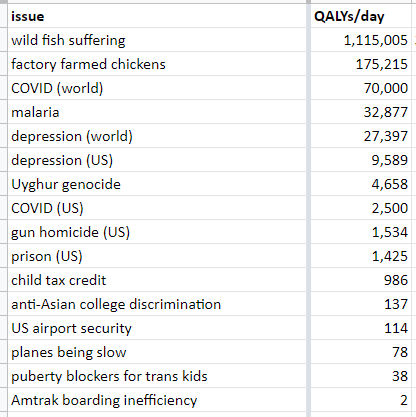
I feel like I don’t spend nearly enough time thinking about the relative importance of things, you know?

I wanna start doing something like: whenever I hear someone mention a problem, or read about it on twitter, or think about it and get annoyed, try and calculate how bad it is and place it on a list.

I started this today and here’s what I have so far: numbers are really bullshit but I feel like it can be nice to just try to get the relative senses of things?

Keep reading

baconmancr

May I ask why you picked wild fish suffering? Was it just easier to calculate than all wild animal suffering, or would it somehow be easier to address? Who is talking about wild fish suffering that prompted you to add it to your list?

worldoptimization

yeah it seemed easier to calculate just for fish :P

my vague impression is that there aren’t actually that many wild mammals and birds, so to the extent wild animal suffering is a big problem it’s prob coming from fish, insects, and other dumber animals.

I don’t think anyone was talking about it, I just added it on as a natural comparison to factory farming. I was trying to just do proportional to number of neurons as a dumb baseline prior (idk if that’s the right way to think about it or if I got the numbers right)

argumate

how big is human suffering in general given that there are eight billion of us?

worldoptimization

the total human QALYs/day is 21m: that’s 120x my farmed chickens number and 20x my wild fish number.

if you think that moral weight is sublinear in number of neurons, then you can get that chickens are higher relative to humans, but also of course that wild animal suffering is way higher relative to farmed animal suffering. (looks like if you do square root you get that humans are 6x as important as chickens and wild fish are 5x as important as humans)

idk, seems not obvious to me how the total of present-day human experience compares in importance to present-day wild animal experience. farmed animals seem less important either way, but also seem way more tractable than either humans or wild animals

there are some old Carl Shulman blog posts about this

is this using those trillion dark fish they discovered down in the deep?

yeah idk I just took the first result I got from google …

now that I look more closely it is unclear to me if anyone has any idea how many fish there are and if so who

worldoptimization
worldoptimization

I feel like I don’t spend nearly enough time thinking about the relative importance of things, you know?

I wanna start doing something like: whenever I hear someone mention a problem, or read about it on twitter, or think about it and get annoyed, try and calculate how bad it is and place it on a list.

I started this today and here’s what I have so far: numbers are really bullshit but I feel like it can be nice to just try to get the relative senses of things?

Keep reading

baconmancr

May I ask why you picked wild fish suffering? Was it just easier to calculate than all wild animal suffering, or would it somehow be easier to address? Who is talking about wild fish suffering that prompted you to add it to your list?

worldoptimization

yeah it seemed easier to calculate just for fish :P

my vague impression is that there aren’t actually that many wild mammals and birds, so to the extent wild animal suffering is a big problem it’s prob coming from fish, insects, and other dumber animals.

I don’t think anyone was talking about it, I just added it on as a natural comparison to factory farming. I was trying to just do proportional to number of neurons as a dumb baseline prior (idk if that’s the right way to think about it or if I got the numbers right)

worldoptimization

I feel like I don’t spend nearly enough time thinking about the relative importance of things, you know?

I wanna start doing something like: whenever I hear someone mention a problem, or read about it on twitter, or think about it and get annoyed, try and calculate how bad it is and place it on a list.

I started this today and here’s what I have so far: numbers are really bullshit but I feel like it can be nice to just try to get the relative senses of things?

Source URL: https://64.media.tumblr.com/a3656324fb5d01bdd886084639e4674c/08fdfad365ee8ea6-29/s540x810/c83a3111b253bf08f2f2acd835d657faf643f1c3.png
worldoptimization

(just some bullshit intuitions I have, ymmv)

Obviously, optimizing for doing good isn’t the same thing as optimizing for personal happiness. And I think to whatever extent you can rewire your brain to value and seek out the first rather than the second, that’s good. I’ve been trying to do a lot of that especially the past couple years: training myself to get more pleasure and reward out of work, shaping my aesthetics and intuitions to be more utilitarian and more agentic.

But also, I think I probably won’t end up having much effect on the world either way, and I really should be going for the few cases where I have a lot of impact. And I suspect those scenarios just look, for lack of a better word, awesome: I’m awesome, my work is awesome, and my life is awesome. Maybe my life doesn’t look exactly like my or society’s preconceived notions of a good life, but it’s something I’m super excited about.

And like–I think there’s an extent to which talking about tradeoffs too much actually makes them real. I see this at work a lot. When someone says “what if we did X?” it feels like the correct and rational thing to do is to consider how valuable X is per unit time, rank it next to all existing projects, consider the other costs it might have beyond time and factor those in, and eventually slot it in on someone’s stack.

When the alternative is to say, “yeah, X sounds awesome, let’s just do it.”

Yeah, you’re always going to need at least some of the first thing; you can’t “just do” literally everything. But in practice it feels like a lot of the time the first thing just means not much gets done and the second one means a ton of shit getting done.

So anyway, I get that feeling a bit when listening to both sides of these debates. Whether it’s “people should make sacrifices” or “people shouldn’t make sacrifices,” my instinct is that maybe we shouldn’t give the sacrifices the benefit of believing in them. Maybe we should try harder to believe that we can do all the things, and then do them.

worldoptimization

When I was younger, I think a thing that bothered me about EA was that I felt like it required me to disregard which organizations just “seemed good” and instead give to whoever had the highest convincing back-of-the-envelope estimate of impact.

Now I feel like I was thinking about it wrong. Over time I’ve come to accept long-termism and “weird” ideas/causes much more than I did when I first heard about EA, but my impressions of the reasonableness and competence of organizations and people have remained surprisingly stable. (Not to say that they haven’t changed at all, but not a ton.)

I still believe in back-of-the-envelope EV estimates–maybe more than I did before; at least, I feel less internal tension about my belief in them. But also I think they’re really hard to get right, and maybe I was trying to do them at the wrong step.

worldoptimization

EA Global Gothic

People ask what your goals for the conference are. You feel something tugging in the back of your mind, but you can’t quite identify it. “Goals … yes …”

You ask people how their conference is. “Oh, I’m just spending the whole time in one-on-ones.” The one-on-ones are useful. The one-on-ones are always useful.

Someone has marked “interested” on the Bizzabo app. You don’t know what that means. Are you interested in them? Should you set up a one-on-one? Will they set up a one-on-one? In a panic, you close the app. For the rest of the weekend you studiously avoid eye contact.

You tell someone you went to a talk. The horror dawning on their face tells you that you have violated some dread taboo. “You know those are recorded, right?”

People ask if you’ve made progress on your goals for the conference. You think you wrote them down somewhere on Friday, but can’t remember where. You write everything down, hoping to keep your grip on reality, but it somehow gets lost anyway.

Luke Muehlhauser has not emerged from his room the entire conference. People go into the room, and people come out. When they come out they seem … different. No one will speak of what took place, but you observe a haunted look in their eyes.

Everyone is in a one-on-one. You don’t know where these are held, or what is discussed in them. You only know that they are always productive. You wander through an empty dome, looking for someone to talk to. You realize no one can break free of the sinister glamour of one-on-ones.

Amanda Askell is telling you that true propositions are easier to argue for than false ones, and thus reasoned philosophical debate tends toward the truth. It sounds plausible. You slowly nod.

People ask if you’ve achieved your goals for the conference. What is a goal? It sounds like one of those things you had, once. Like hopes, and dreams, and fears.

worldoptimization

What’s the best way to be effectively selfish, if you don’t discount your future self?

I was talking to someone who’s not at all altruistic the other day and it seemed like the actual actions it’s reasonable for us to take aren’t that different. If there’s a 1 bp chance you could live a happy life that lasts for a billion years, that still dominates anything you do to increase your happiness during your natural lifespan. I’d guess there’s only so much you can do to increase your personal chances of living a very long time without affecting anyone else’s (exercise? cryonics? asking random AI researchers to simulate you?). Then it might be reasonable to devote the rest of your resources to reducing existential risk (though depending on your assumptions about the current rate of scientific progress in various fields maybe it’s better to work on life extension or just increasing the rate of progress in AI/brain uploading?)

worldoptimization

People keep asking you to have dinner. You never know if you’re on a job interview, or a career advice session, or a date, or just hanging out as friends. Only rarely do you ever find out.

People keep asking you to Skype. You forgot your Skype password years ago and have never bothered to recover it. You ask if you can meet in person instead. One day in a moment of desperation you borrow a work laptop and find your coworker still logged into Skype. You hope he doesn’t notice. You wonder how long you can keep this up.

You are applying to Open Phil. Your roommate is applying to Open Phil. Your boss’s ex-wife’s second cousin is applying to Open Phil. At least 60% of your metamours are applying to Open Phil. You feel like you have always been applying to Open Phil. You feel like you will always be applying to Open Phil.

People are always in the places you least expect them. When asked they give eerily similar reasons. “Why are you in Berkeley?” “My house was too crowded.” “Why are you in Santa Cruz?” “My house was too loud.” “Why are you in my office? You don’t even work here.” “My house has too many naked people.” You wonder what mysterious hold these houses have over their inhabitants.

Everyone around you thinks that the end of the world is imminent. “Unless Paul’s right, of course.” You wonder who this Paul is. You pray he’s right.

worldoptimization
given up on that whole maximal altruism thing eh. good on you. the world needs more abject callousness.

Sorry, I haven’t actually given up on altruism. I don’t think occasionally annoying your friends by playing the devil’s advocate for Trump is incompatible with altruistic goals?

uhhhh if I were @theunitofcaring I would write a long and stirring essay here about how compassion and helping others is good but instead I will just say that I disagree vehemently with the claim that “the world needs more abject callousness”

worldoptimization

Some notes I made about donations this year: I’ll flesh these out more later but just posting basic thoughts now.

Options:

  • donate to Givewell top charities
    • probably AMF and/or SCI, since those are the ones Givewell recommends based on effectiveness of current funding gaps
    • SCI is nice because it doesn’t depend on the value of saving children’s lives
    • cons: Givewell top charities are obviously not nearly as cost-effective as other things could potentially be
    • also unsure about flow-through effects and far future
  • donate to Open Phil
    • not actually an option this year
    • just putting it down because I suspect I’ll be excited about it when it actually becomes possible
  • donate to animal welfare stuff
    • ACE recommended charities are MFA, THL, GFI
      • not sure about MFA and THL
      • seems like Open Phil is putting a ton of funding into corporate campaigns
      • and I’m not that excited about leafleting and stuff
      • GFI seems promising, review here
  • donate to xrisk stuff
    • not sure if there are any xrisk charities whose effectiveness I feel good about
  • donate to metacharities
    • potentially good area because Open Phil might be less likely to fund these
    • should think about ACE and REG
    • other good metacharities? 
worldoptimization
ozymandias271

Against The Drowning Child Argument

There is an argument commonly known as the Drowning Child Argument, which goes something as follows: Imagine that you’re walking across a shallow pond and you notice that a small child has fallen in, and is in danger of drowning…Of course, you think you must rush in to save the child. Then you remember that you’re wearing your favorite, quite expensive, pair of shoes and they’ll get ruined if you…

View On WordPress

worldoptimization

It is kind of annoying for the drowning child thought experiment that most people don’t have $3500 shoes. (I sometimes ask people to imagine they’re going to ruin their most expensive suit, or dress–for a lot of people this is pretty expensive.) But I feel like the important function of the thought experiment is

  1. establish that people have an intuition that it is obligatory to save the life of a person dying in front of you, even at nontrivial cost to yourself
  2. ask why that intuition doesn’t extend to cases where the person is somewhere else and you can’t actually see them

Why do most people who say “yes you should save the child” not donate at least 10% of their income to effective charities? If it turns out most people don’t actually think it’s obligatory to save the drowning child when you specify that it is a person of their income, wearing $3500 shoes for some reason, then that seems like an important flaw in the thought experiment. But I would guess the reason for most people is that kids saved by AMF are far away and don’t really seem real compared to the kid right in front of you.

Weirdly, “spend a month of every year going on quests to save children” sounds way more demanding and daunting to me than “give 10% of your income.”

worldoptimization

People talk about EA being this all-consuming thing sometimes, but for me it doesn’t really feel that way. Right now I’m earning to give, and so the main thing I need to do for EA is go to work every day and work hard, which is what I would want to do anyway. For the most part I don’t get paid any more money for working more hours. I guess there are things I maybe should be spending time on, like EA community-building and thinking about cause prioritization, but for the most part I think the official EA take on what I should be doing in my free time is “idk, maximize your personal happiness?”

And like, there’s something scary about that? Sometimes on a weekend afternoon I’ll find myself switching from activity to activity, opening and closing a book, starting and stopping a TV show, because the only point of anything right now is to maximize my happiness, and if I’m not really enjoying myself then why am I doing this? I find myself imposing structures, deciding “I will go to Mass every Sunday,” even though I don’t quite know what the point of that is either. And then I go, even though I’m tired and I want to sleep in and I don’t exactly enjoy it, because that seems better somehow than sleeping in and drinking tea in bed and watching Outlander.

I’ve been fantasizing more about having kids lately, and probably part of that is normal biological clock stuff, but I think part of it is that once I have kids, I won’t be trying to be happy anymore, I’ll be trying to make my kids happy. And that seems like a more fulfilling thing to live by. 

When I was a kid, I always thought my mom’s life seemed kind of terrible. After a week of school, all I wanted was to do was play with Barbies and read books and dress up in costumes and generally have fun. Whereas my mom didn’t seem to have fun on weekends, really: when she wasn’t taking us to lessons and activities and playdates, she was cleaning the house or gardening or dropping off the dry cleaning. Even her fun was work: she’d invite friends over for dinner, but that meant hours of grocery shopping and cooking and cleaning up. Now I see it differently; she has a very firm conception of what a good life looks like for her family, and she works to achieve it. And that seems really appealing.

worldoptimization

man I get really annoyed when people are like “look at how we allow people to say insufficiently feminist things without ostracizing them! this is why we don’t have any women”

but this is probably unreasonable, right?

I want to be like This is Erasing Antifeminist Women but I’m sure statistically women are more feminist and more likely to be turned off by people saying insufficiently feminist stuff

I mean when I think about how groups can be more welcoming to women my first thought is “well you can start by not talking about basketball all the time” and I think if a woman got mad at me because she was a huge basketball fan that would be kind of silly

(I mean there could be other differences between the two cases, like maybe the freedom to be honest about your political beliefs is more important to group belonging than the freedom to talk about LeBron whenever he comes to mind, but the general principle is the same)

worldoptimization

today we were talking about the argument that talking about AI risk publicly was actually a really bad move, because various corporations and governments’ response to being told about AI risk was “hey superintelligent AI? that sounds cool we should try to build one!”

and now I’m wondering if AGCbtIitSH?! is actually part of Eliezer’s brilliant plan to discredit himself enough that everyone will stop taking the idea of superintelligent AI seriously

worldoptimization
worldoptimization

The average marriage lasts for 100,000 hours. If used well, you can use this time to improve the lives of hundreds of people.

A lot of people will tell you simply to “marry whoever you’re passionate about.” At 100,000 Hours, we think you can do a lot better. Research shows that passion before marriage is actually a poor predictor of how happy you’ll be in your marriage. Better ways to ensure happiness are dating lots of people before marriage to get an idea of your compatibility along different dimensions, marrying someone with whom you share similar interests and values, and taking an IAT to check if you have positive associations with your future spouse.

Everyone wants a happy marriage, but if you’re reading this it’s probably because you want more from your marriage than just happiness for your and your spouse–you want to help the world. Luckily, these two goals don’t have to conflict. For one thing, an unhappy marriage will make you less productive, helping no one. For another, making a marital decision that makes the world a better place is one of the best ways to find personal fulfillment in your marriage. Below is a quick introduction to our social impact marriage advice.

Question 1: EA or non?

This is probably the biggest issue. It really depends on how committed of an EA you are. If you’re very committed, the best course of action is to marry someone who is on the margin of being an EA, but is unlikely to stick with it without your influence. If you’re on the less committed end of the EA spectrum (do you sneak dairy products when no one’s looking? fantasize about owning a yacht?), try marrying someone particularly moral. Ideally just thinking about their reaction should be enough to stop you doing anything wrong.

Question 2: What should I consider before I marry a non?

If you’re a woman marrying a man, be careful–unfortunately men adopting the ideologies of their wives is frequently seen as low-status. In any case, make sure your spouse is someone who gets along with EAs socially and is not firmly anti-EA–these are good indicators of EA potential. And your spouse’s potential to contribute to the EA movement–by getting a high-paying job or doing valuable direct work–is an important consideration as well.

Question 3: What about children?

Whether or not to have children is an important and contentious issue we won’t get into at the moment. If you’ve decided not to reproduce, marry someone who is firmly in agreement with you. If you want to be really safe, we recommend marrying a man–men are less likely to decide later in life that they want children after all.

If you do want to have children, remember that shared environment never explains any variance in anything, so by far the biggest parenting decision you’ll make is whose genetic material you want to combine yours with. An EA spouse will make your kids more likely to be EA (obviously the most important thing) and beyond that look for high intelligence, conscientiousness, charisma, attractiveness, and anything else that’s a predictor of career success.

Question 4: What about MtG?

It’s a common misconception that we recommend all EAs “marry to give,” or marry a high-net-worth individual with the intent of redirecting much of their wealth to effective causes. In retrospect, we emphasized this idea too much in our early days, and as the most controversial of our suggestions it attracted a lot of press. In fact, we recommend that only a small fraction of EAs pursue MtG. MtG is probably best suited to attractive people, those with good social skills, those who fit in well in high-status and wealthy circles, and women looking to marry men–hardly a large percentage of the EA community. And if you do think that MtG is a good fit for you, we recommend that you still marry someone you like. Marrying someone you dislike is likely to lead to burnout and unhappiness, which will make you less effective in your other goals.

Question 5: Okay, I have a good idea of what I’m looking for in a spouse now. How I do find one?

If you’re looking for an EA spouse, try looking in EA communities, either online or IRL. Otherwise, try your school or workplace or asking around among friends. And of course, there’s EACupid, where you can fill out a short quiz and our recommendation engine will find the optimal spouse for you!


hunterstheorem

See, the funny thing about this parody is that people _are_ famously bad at thinking out their choices of spouse, and in terms of both happiness _and_ charitable success (not to mention pretty much anything else) a careful analysis of factors like 80,000 hours does would totally be useful.

But let’s just sneer at those weirdos, that sounds more fun.

gruntledandhinged

I mean, I *really* don’t think this was sneering, especially given how many people who reblogged it are in this community (notably, on Facebook a bunch of the 80k staff were posting it happily).

(Though tbh, I would not be very comfortable with this community giving me any kind of relationship advice)

worldoptimization

Can confirm I was not trying to sneer at weirdos, I am in fact an EA who is planning to earn to give and my only intention was to countersignal affection for the ingroup.

(the advice in my post was obviously a bit over the top but I do agree that people can be bad at choosing spouses and thinking about it carefully/systematically is a good idea)

worldoptimization

The average marriage lasts for 100,000 hours. If used well, you can use this time to improve the lives of hundreds of people.

A lot of people will tell you simply to “marry whoever you’re passionate about.” At 100,000 Hours, we think you can do a lot better. Research shows that passion before marriage is actually a poor predictor of how happy you’ll be in your marriage. Better ways to ensure happiness are dating lots of people before marriage to get an idea of your compatibility along different dimensions, marrying someone with whom you share similar interests and values, and taking an IAT to check if you have positive associations with your future spouse.

Everyone wants a happy marriage, but if you’re reading this it’s probably because you want more from your marriage than just happiness for your and your spouse–you want to help the world. Luckily, these two goals don’t have to conflict. For one thing, an unhappy marriage will make you less productive, helping no one. For another, making a marital decision that makes the world a better place is one of the best ways to find personal fulfillment in your marriage. Below is a quick introduction to our social impact marriage advice.

Question 1: EA or non?

This is probably the biggest issue. It really depends on how committed of an EA you are. If you’re very committed, the best course of action is to marry someone who is on the margin of being an EA, but is unlikely to stick with it without your influence. If you’re on the less committed end of the EA spectrum (do you sneak dairy products when no one’s looking? fantasize about owning a yacht?), try marrying someone particularly moral. Ideally just thinking about their reaction should be enough to stop you doing anything wrong.

Question 2: What should I consider before I marry a non?

If you’re a woman marrying a man, be careful–unfortunately men adopting the ideologies of their wives is frequently seen as low-status. In any case, make sure your spouse is someone who gets along with EAs socially and is not firmly anti-EA–these are good indicators of EA potential. And your spouse’s potential to contribute to the EA movement–by getting a high-paying job or doing valuable direct work–is an important consideration as well.

Question 3: What about children?

Whether or not to have children is an important and contentious issue we won’t get into at the moment. If you’ve decided not to reproduce, marry someone who is firmly in agreement with you. If you want to be really safe, we recommend marrying a man–men are less likely to decide later in life that they want children after all.

If you do want to have children, remember that shared environment never explains any variance in anything, so by far the biggest parenting decision you’ll make is whose genetic material you want to combine yours with. An EA spouse will make your kids more likely to be EA (obviously the most important thing) and beyond that look for high intelligence, conscientiousness, charisma, attractiveness, and anything else that’s a predictor of career success.

Question 4: What about MtG?

It’s a common misconception that we recommend all EAs “marry to give,” or marry a high-net-worth individual with the intent of redirecting much of their wealth to effective causes. In retrospect, we emphasized this idea too much in our early days, and as the most controversial of our suggestions it attracted a lot of press. In fact, we recommend that only a small fraction of EAs pursue MtG. MtG is probably best suited to attractive people, those with good social skills, those who fit in well in high-status and wealthy circles, and women looking to marry men–hardly a large percentage of the EA community. And if you do think that MtG is a good fit for you, we recommend that you still marry someone you like. Marrying someone you dislike is likely to lead to burnout and unhappiness, which will make you less effective in your other goals.

Question 5: Okay, I have a good idea of what I’m looking for in a spouse now. How I do find one?

If you’re looking for an EA spouse, try looking in EA communities, either online or IRL. Otherwise, try your school or workplace or asking around among friends. And of course, there’s EACupid, where you can fill out a short quiz and our recommendation engine will find the optimal spouse for you!

worldoptimization
chroniclesofrettek

I haven’t had my caffeine this morning, so I’m not being very charitable, “effective altruism is just asking how to best promote global welfare, that’s not controversial!” sounds a lot like some other claims about ideologies that you see around tumblr and other social media.

worldoptimization

Yeah I never understood why people liked to make the definitional argument for feminism until I started reading critiques of EA and found that my first thought was “But you’re just disagreeing on what’s effective, not disagreeing with effective altruism! Effective altruism is literally just the idea that we should use evidence and reason to make the world a better place! What kind of terrible person could disagree with that?”

I think the situations are pretty similar; EA, like feminism, is not a one-sentence proposition but a diverse movement founded on a kind of weird, not at all obvious framework for thinking about the world. And the “but it’s obvious, look at the definition” is not only totally unhelpful for promoting productive engagement with critics, but at least when it’s done to me it really pisses me off so I’m gonna try not to do it to other people.

When people are like “EA is philosophically trivial” I wonder about the sort of bubble they’re living in … I guess the thinnest possible version of EA is trivial if you’re consequentialist (although you could still think that the EA movement is doing it wrong enough not to be worth anyone’s time) but most people aren’t consequentialist and can’t be convinced to become consequentialist.

worldoptimization
worldoptimization

The thing about making EA more welcoming though is that it seems hard to determine what discourse norms will actually get you more people on net.

I mean, I’m an EA because I think the philosophical arguments are correct. But I never would have even listened to the arguments if I hadn’t been drawn in by the community first. And what drew me in about the community?

  • full of programmers and philosophers
  • willing to argue about the methodology of studies or the details of population ethics at very little provocation
  • conversations about the Silmarillion (which I haven’t even read but still)
  • capable of discussing the pros and cons of murdering babies in a calm and rational manner
  • ridiculous thought experiments and in-group jargon
  • the kind of place where you can refer to the thin line between feminism and literally Voldemort and no one will storm out of the room

Like high-variance strategies are a thing, “make EA as non-weird as possible” seems unlikely to actually be the best way to do recruitment.

spiralingintocontrol

so… yes, high-variance strategies are a thing, but they make more sense in the context of dating, where you only want a limited number of partners and so only attracting the best one(s) is a good idea

but EA is something that could benefit from having as many people as possible contributing to it over time! so it’s different. although we still likely want to do some amount of selection for people whose beliefs are at all compatible with EA.

but for example, I think a lot of Christians who take charity really seriously could potentially be really into EA, except… well, this community likely isn’t as welcoming to that type of person (as far as I know, which is of course not very much, since I’m an atheist and don’t really know any religious people).

worldoptimization

Yeah, I agree our strategy should be less high-variance here than in dating. And I’m on board with getting as many people into EA as possible. And I support the suggestions that are like “be friendly to people” and “listen to people about their experiences rather than just trying to convert them.” 

I just think

  1. if people criticize the way EAs talk to other EAs because they’re afraid it will turn people off it will make the movement a less fun place to be
  2. there’s a possible future where we try to appeal to both devout Christian art history majors and utilitarian programmers and end up being bland enough that we appeal to neither
worldoptimization

The thing about making EA more welcoming though is that it seems hard to determine what discourse norms will actually get you more people on net.

I mean, I’m an EA because I think the philosophical arguments are correct. But I never would have even listened to the arguments if I hadn’t been drawn in by the community first. And what drew me in about the community?

  • full of programmers and philosophers
  • willing to argue about the methodology of studies or the details of population ethics at very little provocation
  • conversations about the Silmarillion (which I haven’t even read but still)
  • capable of discussing the pros and cons of murdering babies in a calm and rational manner
  • ridiculous thought experiments and in-group jargon
  • the kind of place where you can refer to the thin line between feminism and literally Voldemort and no one will storm out of the room

Like high-variance strategies are a thing, “make EA as non-weird as possible” seems unlikely to actually be the best way to do recruitment.

worldoptimization
nihilsupernum

ok so i don’t really understand the sj/feminist/whatever framework beyond what ive seen on tumblr and have no interest in doing so, so i might be using the words wrong

however

veganism/vegitarianism is not a privilege. it is associated with rich people, but it’s not actually expensive. grain is cheap, meat is $$$. veganism* can be human-capital-expensive; junk food is easier to procure and eat, etc., etc., but the concept of being “too poor to be vegan” is confused.

i am not a vegan because i am a moral nihilist and see no need to be. i would be willing to eat human flesh were it not socially unacceptable/psychologically a bad idea/likely to get me sent to jail

the idea of saving animals by being a vegan is basically homeopathy anyway if the counterfactual is buying meat from stores that buy it from larger suppliers that but it from… certainly if an animal is already dead and nobody will know you are of it no harm is done.

but anyway, if you think veganism is a moral imperative and aren’t a vegan, look into things like ordering grain in bulk online

worldoptimization

I mostly agree on the privilege thing except it is true that being vegetarian has a social cost that varies depending on the community you’re in and that’s definitely correlated with wealth

as someone who’s tried to eat vegetarian at restaurants in rural Indiana and ended up eating salad and fries for dinner, I can see why someone from rural Indiana would get annoyed at someone from an urban Blue Tribe enclave being like “but it’s so easy to be vegetarian, every restaurant has at least five clearly marked vegetarian options!”

also being vegan doesn’t really save animals, I think the main reason to do it is if you think animals on factory farms have lives not worth living and you want to reduce demand for animal products thereby preventing some of them from being born in the first place

(main utilitarian reason that is, most vegans are probably so for non-utilitarian reasons)

worldoptimization

I don’t know when religion got so consumerist, or if it always has been and I just wasn’t paying attention.

I have a friend who goes to church whenever she feels like it, usually twice a year, and prays when she wants something. Another friend who says she wants her kids to believe in God, not so they can act on their religion but just so they think there’s someone looking out for them, to make things easier. And I think that’s normal. Most people I know ask what God can do for them, not what they can do for God.

(Lord, make me an instrument of Your peace)

People tell me that the Catholic Church is okay but they really need to liberalize on same-sex marriage and contraception if they want to appeal to the younger generation, like they’re the Republican party or something, like divinely inspired truth obeys the median voter theorem.

(Grant that I may not so much seek to be understood as to understand)

I don’t believe that there is a god but I alieve that He is a demanding god. Jesus didn’t tell us to try to be pretty okay people: that’s what we try to do anyway. That’s the baseline. He told us go sell what thou hast, and give to the poor, and follow me. 

(Where there is despair, let me sow hope)

That’s why I think effective altruism is a more real religion then most religions. We give you the sacred texts to read and tell you to come to services every week. We ask everything of you and in return we give your life a joyful purpose. We tell you to lay up for yourselves treasures in heaven and that it is easier for a camel to pass through the eye of a needle than for a rich man to enter into the kingdom of God and we mean it.

(For it is in giving that we receive)

worldoptimization

so my little sister sent me this email

I was inspired by your blog and especially the article on defective altruism to write a poem.  Some people might say it’s a waste of time, but I think there’s nothing more important than converting people to the doctrine of effective altruism, so I wrote a poem to definitively prove that effective altruists are better than people who give to charity only in an attempt to look kind.  


You warm, you soft, superior gods 
who live in castles preaching your love 
who pose beside the wretches you help 
saying, shouting, “Look! I’m so kind!" 
But kindness isn’t what you possess; 
it’s wanting joy to fill every mind. 
It’s looking past what keeps us apart 
to find you want what’s best for us all. 
It’s seeing how your efforts could help, 
a want to do the most that you can. 
And wanting, then, to do the most good 
is never mean, it’s perfectly kind. 
And all you guys just suck.

(disclaimer I do not actually endorse hostile messaging)